Types of MCB (Miniature Circuit Breakers)
Miniature Circuit Breakers (MCBs) are safety devices installed in consumer units (fuse boards) to protect electrical circuits from overload and short circuit faults.
If too much current flows through a circuit, the MCB will automatically switch off to prevent overheating, fire risk, or damage to wiring and electrical equipment.
MCBs work in a similar way to traditional fuses that blow, but they are more convenient because once the fault has been identified and corrected, the breaker can simply be reset by switching it back on, rather than replacing a fuse.
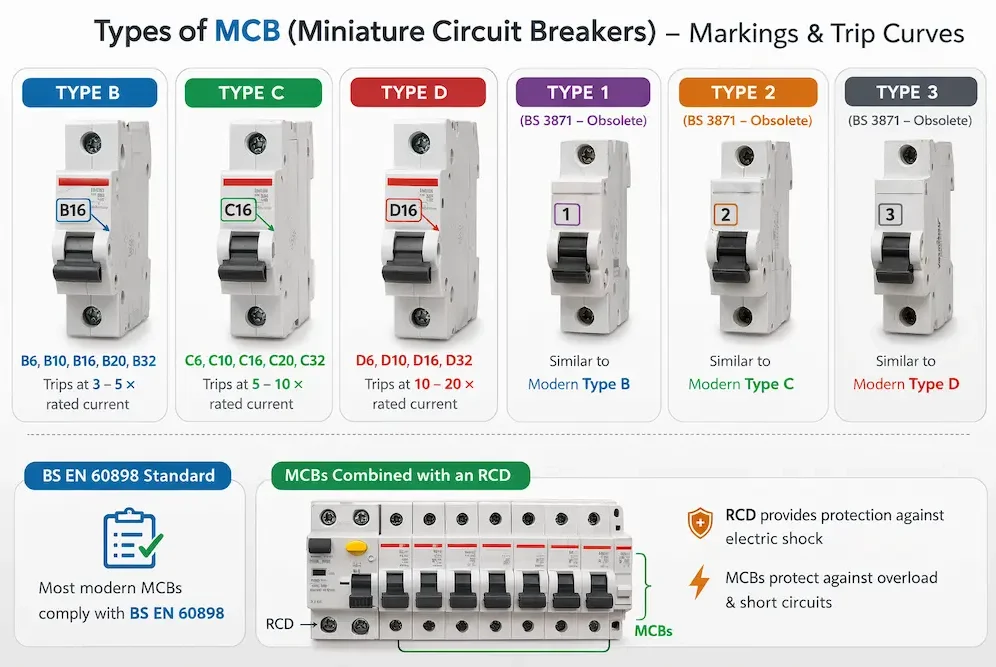
Most MCBs used in modern consumer units comply with the BS EN 60898 standard, which sets out the requirements for circuit breakers used in domestic and similar installations.
In many consumer units, a group of MCBs are installed alongside an RCD (Residual Current Device) which provides additional protection against electric shock by disconnecting the supply if an earth leakage fault is detected.
Different types of MCB are designed to trip at different levels depending on the type of electrical equipment connected to the circuit.
You can see this shown as a trip time curve or graph, which illustrates how quickly the breaker will switch off depending on how much current is flowing. In simple terms, the graph shows that the higher the fault current, the faster the breaker disconnects the circuit. These curves can be seen in the BS 7671 Wiring Regulations (the “Regs book”), which electricians use when designing and testing circuits.
The most common types used in domestic installations are Type B, Type C and Type D.
Type B MCB
Type B MCBs are the most commonly used breakers in domestic consumer units.
They typically trip when the current reaches 3 to 5 times the normal rated current of the breaker.
This makes them suitable for most household circuits where large start-up currents are not expected.
You can usually identify a Type B breaker by the marking on the front of the MCB, such as B6, B10, B16, B20 or B32, where the letter B indicates the trip curve and the number shows the current rating in amps.
Common uses include:
• Lighting circuits
• Socket circuits
• General household wiring
Type C MCB
Type C MCBs are designed to tolerate higher start-up currents before tripping.
They typically trip when the current reaches 5 to 10 times the rated current.
These breakers are often used where equipment may produce a temporary surge of current when switched on.
Type C MCBs are commonly used in commercial and industrial installations, particularly where motors or equipment with higher starting currents are present. However, they may also be used in domestic installations where certain equipment produces a higher inrush current.
Motors and compressors can draw a high inrush current when starting, which may cause a Type B breaker to trip unnecessarily, making Type C more suitable in these situations.
Type C breakers are usually marked on the front of the device as C6, C10, C16, C20 or C32, where the letter C identifies the trip curve and the number indicates the current rating in amps.
Common uses include:
• Circuits supplying motors
• Air conditioning units
• Commercial lighting
• Small workshops or garages
Type D MCB
Type D MCBs allow a much higher temporary surge before tripping.
They typically trip when the current reaches 10 to 20 times the rated current.
Because of this, they are not normally found in domestic consumer units and are more commonly used in industrial or specialised equipment installations where large starting currents are expected.
Type D breakers can be identified by markings such as D6, D10, D16 or D32, where the letter D indicates the trip curve and the number shows the current rating in amps.
Common uses include:
• Large motors
• Transformers
• Industrial machinery
Specialised and Older Types
Type K and Type Z MCBs
In addition to Type B, C and D, there are some less common MCB types used for specialised applications.
These breakers are not normally found in domestic consumer units and are more commonly used in specialised or industrial installations.
• Type K – Trips at around 8 to 12 times its rated current. Often used on circuits supplying motors or equipment with higher starting currents.
• Type Z – A very sensitive breaker designed to trip quickly at relatively low fault currents. Sometimes used to protect sensitive electronic equipment such as semiconductor devices.
Older MCB Types (BS 3871)
In older installations you may sometimes see circuit breakers that comply with the BS 3871 standard. These breakers were produced in Types 1, 2, 3 and 4.
Although now considered obsolete, they broadly correspond to modern breaker types as follows:
• Type 1 – similar to modern Type B
• Type 2 – similar to modern Type C
• Type 3 – similar to modern Type D
• Type 4 – designed for circuits with very high starting currents, typically found in industrial equipment
These older breakers are still found in some consumer units but will be replaced when a consumer unit upgrade is carried out.
Why the Correct MCB Type Matters
Using the wrong type of MCB can cause problems.
A breaker that is too sensitive may trip unnecessarily when equipment starts up.
A breaker that allows too much current may not provide adequate protection for the circuit.
For this reason, MCB types should always be selected according to the circuit design and the requirements of BS 7671 Wiring Regulations.
Fault Protection and Disconnection Times
In addition to protecting against overloads and short circuits, an MCB must also operate quickly in the event of a live to earth fault.
For this to happen safely, the earth fault loop impedance of the circuit must be low enough to allow sufficient fault current to flow and cause the MCB to trip within the required disconnection time.
Different types of MCB require different levels of fault current in order to operate correctly. Because of this, the earth fault loop impedance must be suitable for the type of breaker installed.
For example, installing a Type C MCB on a circuit where the earth fault loop impedance is too high may prevent the breaker from disconnecting within the required time, which could leave the circuit inadequately protected.
This is one reason electrical circuits are tested during inspections such as an Electrical Installation Condition Report (EICR) to confirm that protective devices will operate correctly in the event of a fault.
MCB vs RCBO
Modern consumer units often use RCBOs instead of MCBs.
An RCBO combines two types of protection in one device:
• Overcurrent protection (like an MCB)
• Earth leakage protection (like an RCD)
Need Advice on Electrical Safety?
If you need help with consumer units, circuit breakers, electrical installations, lighting, or inspections such as an EICR, RW Currion Electrical provides professional electrical services in Banbury and the surrounding towns and villages.
All work is carried out in accordance with the latest BS 7671 Wiring Regulations to ensure electrical systems remain safe and compliant.
You may also find these guides useful:
• RCD / RCBO Explained
• What Is an EICR?
• Class 1, Class 2 and Class 3 Electrical Equipment
Call now: 01295 533378
Mobile: 07740 100378