
Can I Have an EV Charger Without a Driveway?
There are a lot of questions around home EV charging for people who do not have a driveway and have to park on the street. A home EV charger may still be possible, but the parking position, cable route and path or pavement access all need proper checking.
Many homeowners search for whether an EV charging cable can cross a path or pavement from the house to the car. This often comes up with terraced houses, properties with on-street parking, shared paths or parking spaces that are separate from the house.
The important thing is not just whether the charger can be fitted on the wall. The cable route also has to be safe, practical and suitable for regular use, without creating a risk for children, older people, pushchairs, wheelchair users, blind or partially sighted people, people distracted by phones, or anyone else using the path.
A loose EV charging cable across a path, or one of those rubber cable covers often used in offices, is not something I would treat as a proper long-term outdoor charging solution.
For some homes, an EV cable gully or proper cross-path cable route may be an option. For other homes, it may need council, landlord or freeholder approval, especially if the cable crosses a public pavement or shared access.
RW Currion Electrical installs EV chargers in Banbury and nearby villages including Adderbury, Bloxham, Bodicote, Deddington and Kings Sutton.
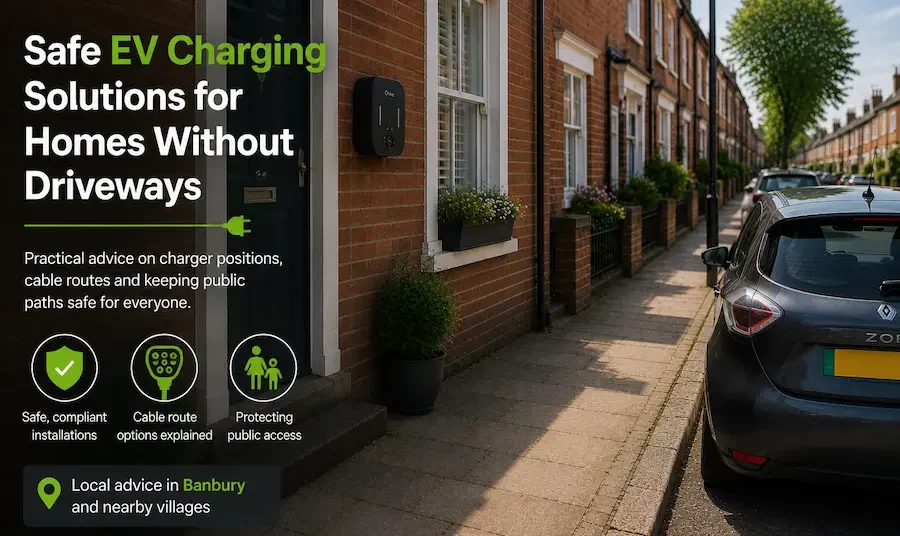
Homes without driveways need careful advice on EV charger position, cable routes and keeping paths safe for pedestrians, pushchairs and mobility users.
What Needs Checking Before Installing an EV Charger Without a Driveway?
Before fitting an EV charger, the parking position and cable route need to be looked at properly.
The main things to check are:
• Normal parking position for the car
• How close the car can usually be parked to the property
• Best position for the charger
• Possible charging cable route
• Whether the cable would cross a path or pavement
• Whether the path is private, shared or public
• Who else uses the route
• Whether a cable gully may be needed
• Any landlord, freeholder or council permission needed
A home EV charger may still be possible, but the answer depends on the property. Some homes only need a sensible charger position and safe cable route. Others may need a proper cable gully, permission from the council or a different charging solution altogether.
Can an EV Charging Cable Cross a Path or Pavement?
An EV charging cable should not simply be left trailing across a path or pavement as a regular charging arrangement.
We were recently asked whether an EV charging cable could be run across a path inside one of those high-visibility rubber cable covers often used in offices, workshops or events.
I would be very cautious with that idea.
It may seem like an easy answer, but a cable across a walkway can quickly become a trip hazard. This can be an issue for pedestrians, children, older people, wheelchair users, mobility scooters, pushchairs, delivery drivers and neighbours using a shared path.
Those rubber cable covers are usually intended for temporary or controlled situations. They are not the same as a proper permanent cable route for regular outdoor EV charging.
Possible problems include:
• They can move
• They can lift at the edges
• They can still create a trip hazard
• They may not sit properly on uneven ground
• They can be affected by rain, frost, mud and sunlight
• They may make access harder for wheelchairs and pushchairs
• They may not be acceptable on a public pavement or shared path
• They do not solve the issue of who owns the path
If the path is on your own property, there may be ways to make the route safer. If the cable needs to cross a public pavement, it becomes a bigger issue because the pavement is normally controlled by the local authority.
That does not mean it is always impossible, but it does mean the route needs proper checking before anyone assumes a charger can be installed.
For a permanent EV charging setup, the cable route needs to be properly planned. A loose rubber cover across a path is not the same as a proper EV cable gully or approved crossing solution.
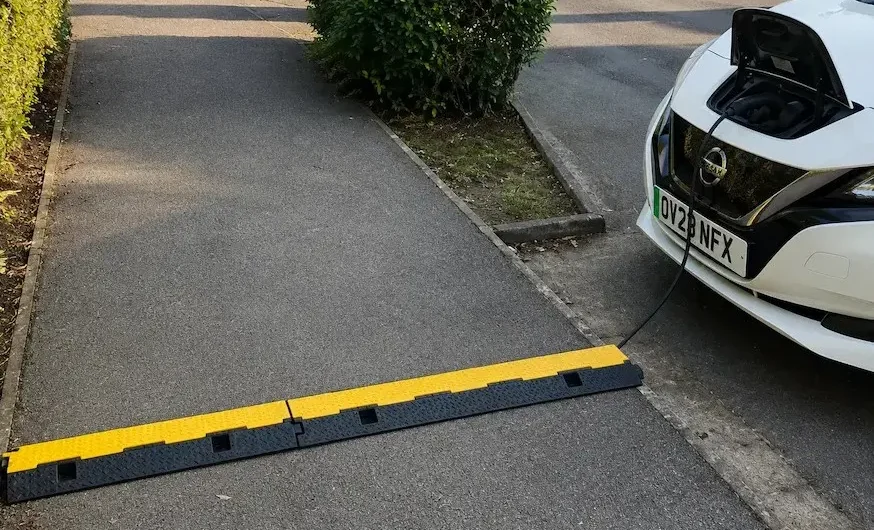
A rubber cable cover may look like an easy answer, but for regular EV charging it is not the same as a proper cable gully or approved crossing solution. It can still create a trip hazard and a risk to the public.
What Is an EV Cable Gully?
An EV cable gully is a recessed channel that allows an EV charging cable to pass across a path more neatly and safely.
Instead of the cable lying loose on top of the surface, the cable sits in a channel. Some systems have a lid or cover designed for regular outdoor use.
Where a cable needs to cross a path regularly, a proper EV cable gully is the safer and more suitable option than leaving a loose cable or using a temporary rubber cable cover.
These are sometimes called:
• EV cable gullies
• Cable channels
• Pavement charging channels
• Cross-pavement charging solutions
• EV charging gullies
They are usually considered where the charger is fitted to the house, but the car is parked across a path or on the road.
The important part is not just choosing a product. The important part is whether it is suitable for that location and whether permission is needed.
Who Can Install an EV Cable Gully?
Who installs the EV cable gully depends on where the path or pavement is.
If the cable gully is crossing a public pavement, this is normally controlled by the local council or highway authority. You should not assume an electrician, builder or homeowner can simply cut a channel into the public footpath. The council may have its own application process, approved products and approved contractors.
If the cable gully is on your own private path, the work may be more straightforward. The gully would usually be fitted by a competent builder, groundworker or suitable contractor, rather than as part of the electrical installation itself.
If the path is on landlord, freeholder, housing association or management company land, permission will normally be needed before any gully or cable channel is installed. They may also have their own rules about who is allowed to carry out the work.
It is normally the customer’s responsibility to arrange any permission, council approval, landlord consent, builder, groundworker or approved contractor needed for the cable gully.
As the electrician, my job is to advise on the EV charger position, cable route and electrical installation. The actual gully work depends on who owns or controls the path. For public pavements, that usually means the council. For private paths, it is usually a builder, groundworker or approved contractor.
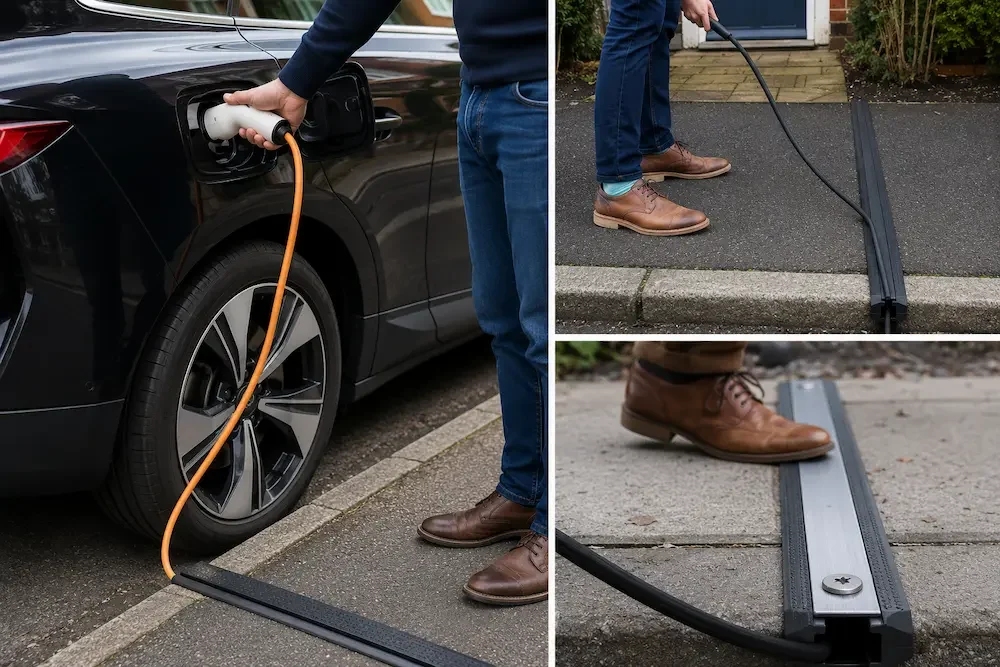
Example of a cross-pavement EV charging channel from official UK government guidance. The cable sits in a recessed route rather than trailing loose across the pavement.
Image source: GOV.UK cross-pavement EV charging guidance
Why the EV Charger Location Matters
The best charger position is not always the closest wall.
For homes without a driveway, the charger location needs to be chosen carefully. The aim is to keep the charging cable route as short, safe and practical as possible.
Things that may affect the charger position include:
• Where the car is normally parked
• Location of the consumer unit or meter
• Best route for the supply cable
• Need for a CT clamp or load balancing
• Choice of tethered or untethered charger
• Safe route across any private path
• Any cable gully or permission needed
Sometimes moving the charger position slightly can make the whole installation safer and neater.
Related EV Charger Advice
If you are planning a home EV charger installation, these advice pages may also help:
• EV Charger Installation in Banbury
• EV Charger Advice
• Best Location for an EV Charger
• Can I Charge an EV From a Normal Socket?
• How Is a Home EV Charger Wired?
• Tethered vs Untethered EV Chargers
EV Charger Installation in Banbury and Nearby Villages
If you’re thinking about having an EV charger installed at home but do not have a driveway, the cable route is one of the most important parts of the job.
RW Currion Electrical installs dedicated home EV chargers across Banbury and the surrounding villages, giving homeowners clear advice on whether a home charger is practical, safe and suitable for regular use.
This can include checking:
• How close your car can usually be parked to the property
• Best position for the EV charger
• Possible charging cable route
• Any private path, shared path or public pavement involved
• Need for a cable gully or protected route
• Any landlord, freeholder or council permission required
• Consumer unit, earthing and bonding suitability
• Load balancing requirements
For regular EV charging at home, a dedicated charger is usually the better long-term solution than using a 3-pin plug. But for homes without a driveway, the cable route needs proper checking before assuming an installation is possible.
Learn more on our EV charger installation service page or contact Richard for honest advice.
Call now: 01295 533378
Mobile: 07740 100378