
How Is a Home EV Charger Wired?
A home EV charger needs to be wired properly from the start. It is not something that should be connected into the nearest socket circuit, garage supply or old outside cable.
A new charger will need its own dedicated electrical circuit, installed from a suitable point in the property and protected correctly.
Customers sometimes ask whether an EV charger can be connected to an existing socket circuit. For a dedicated EV charger unit, it should have its own circuit so the cable, protective device and testing are all suitable for the load.
A home EV charger can run at up to 32 amps for long periods, so it needs to be treated differently from an ordinary socket circuit. The circuit has to be designed for continuous high load.
The exact wiring route depends on the layout of the house, the position of the consumer unit, the meter location, the driveway, the earthing arrangement and where the charger is going to be fitted.
For many homeowners, the biggest worry is not the charger itself. It is how the cable will get from the electrical supply to the charger without causing unnecessary disruption.
RW Currion Electrical installs home EV chargers in Banbury, Adderbury, Bloxham, Bodicote, Kings Sutton and nearby villages. Richard plans each installation properly first, including the cable route, consumer unit, earthing, load requirements, charger position, testing, certification and DNO notification where required.
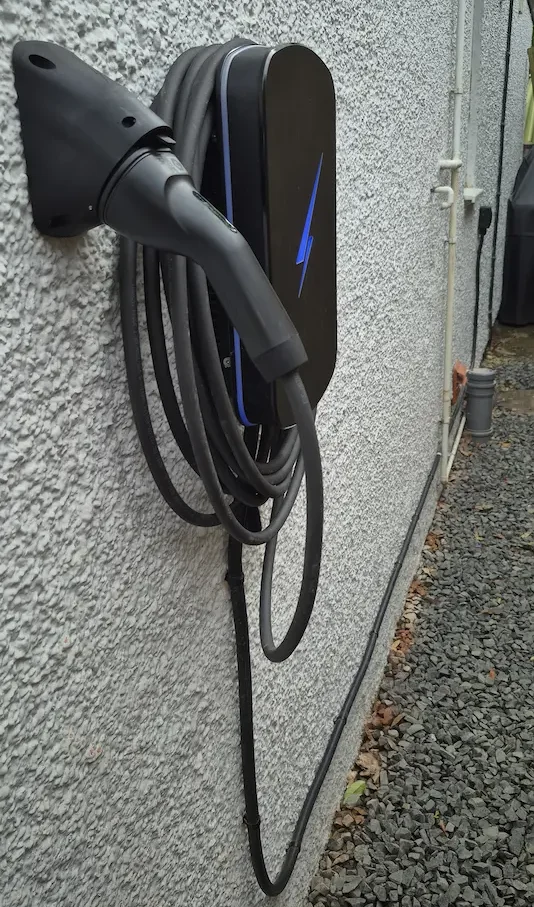
Hypervolt EV charger installation in Adderbury near Banbury, with an external
cable route used to keep the installation neat and practical.
Does an EV Charger Need Its Own Circuit?
Yes. A home EV charger will need its own dedicated circuit.
This means the charger will have its own cable, its own protective device and its own electrical testing. It should not be connected into an existing socket circuit, garage circuit or old outdoor supply.
An EV charger is a high-load item that can run for several hours at a time. Because of this, the circuit must be designed properly for the charger, the cable route, the property supply and the existing electrical installation.
A typical home EV charger installation will include:
• A dedicated EV charger circuit
• Correctly sized cable
• Suitable circuit protection
• RCD or RCBO protection where required
• Surge protection where suitable
• PEN fault protection, either built into the charger or provided separately
• Load balancing where needed
• Testing and certification
• DNO notification where required
• Part P notification for notifiable domestic electrical work
How Is the Cable Run to the Charger?
Common EV charger cable routes include:
• Under floorboards
• Through a garage
• Around the outside wall
• From an external meter position
• Through a loft or void where suitable
• Through cupboards or utility areas
• Along a side passage
• Underground or through ducting in some situations
The aim is to find a safe, tidy route that works properly for the house.
Sometimes lifting floorboards is the cleanest option because the cable can be hidden inside the property. Sometimes an external cable route is better because it avoids disturbing floors, decoration or finished rooms.
The best route is not always the shortest route. It is the route that works properly for the installation and causes the least sensible disruption.
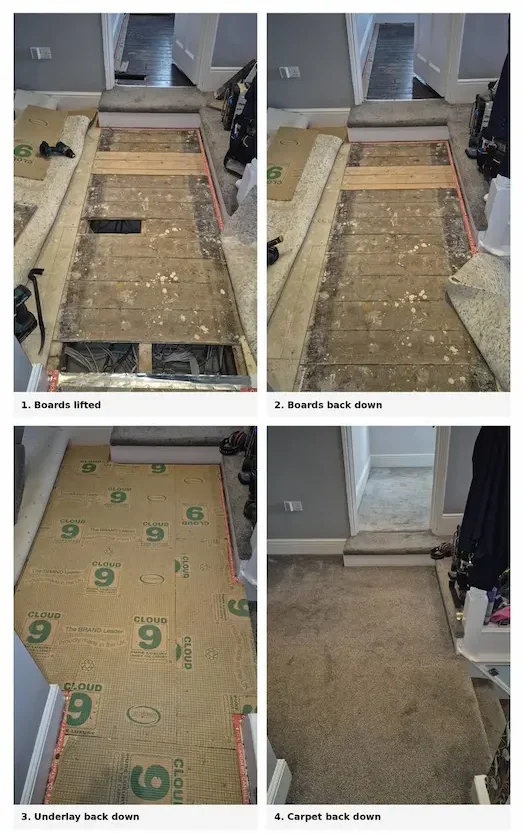
The photo below shows a recent EV charger installation in Adderbury. I had worked on this house previously, so I knew the floorboards could be lifted neatly without causing unnecessary damage. Once the cable had been routed from the consumer unit to the garage, the boards were screwed back down, the underlay and carpet were refitted, and the customer’s furniture was put back in place.
Do Floorboards Need to Come Up for an EV Charger Cable?
If the consumer unit is inside the house and the charger is outside, lifting floorboards may be one way to hide the cable neatly. This can be especially useful where the cable needs to cross from one side of the property to another.
When floorboards are lifted, the route needs to be planned carefully. The cable must be installed so it is protected from damage and routed sensibly.
In some homes, floorboards do not need to come up at all. A route through a garage, outside wall, utility area or external consumer unit may be more suitable.
If you have chipboard flooring that has never been lifted before, we will usually try to find another cable route where possible. This is because chipboard floors can be difficult to lift neatly without causing damage to the boards.
What Cable Is Used for a Home EV Charger?
The cable used for a home EV charger depends on the charger, the length of the cable run, the installation method and the design of the circuit.
Many domestic EV chargers are rated up to 7.4kW on a single-phase supply. The cable must be sized correctly for the load, the route, the installation conditions and voltage drop.
Some EV charger installations use EV Ultra cable. This can include both the power cable and a data cable inside the same outer sheath. That can be useful where the charger needs a data connection for load balancing, CT clamp communication or other smart features.
Other installations may use SWA armoured cable, twin and earth cable in suitable protected areas, and a separate Cat5e data cable depending on the charger and the route.
Armoured cable is not always needed for the full route. It may be used where the cable needs extra mechanical protection, especially outside, in garages, around driveways or anywhere it could be knocked or damaged.
If the cable is run inside the house, under floors, through suitable voids or in protected containment, twin and earth cable may be suitable instead.
The important part is that the cable is designed for the actual installation. It should not be guessed from the charger rating alone. The cable type, size, route and protection all need to suit the property and the charger being installed.
What If an EV Cable Cannot Easily Be Run to the Consumer Unit?
In some homes, running a new EV charger cable back to the main consumer unit can be difficult, messy or impractical.
The consumer unit might be in the middle of the house, in a finished hallway, under the stairs, in a kitchen cupboard or on the opposite side of the property from the driveway. In those situations, it may be better to look at another safe wiring route.
One option is to install a small weatherproof EV consumer unit outside, close to the meter position, if the supply arrangement is suitable. This can sometimes provide a neater route to the charger and avoid unnecessary disruption inside the house.
This is not always possible, and it depends on the existing meter position, supply equipment, earthing arrangement, main fuse size and space available. The installation still needs to be designed properly, protected correctly, tested and certified.
Where suitable, an external EV consumer unit can be a good option for homes where the charger is close to the meter box but awkward to wire from the main consumer unit.
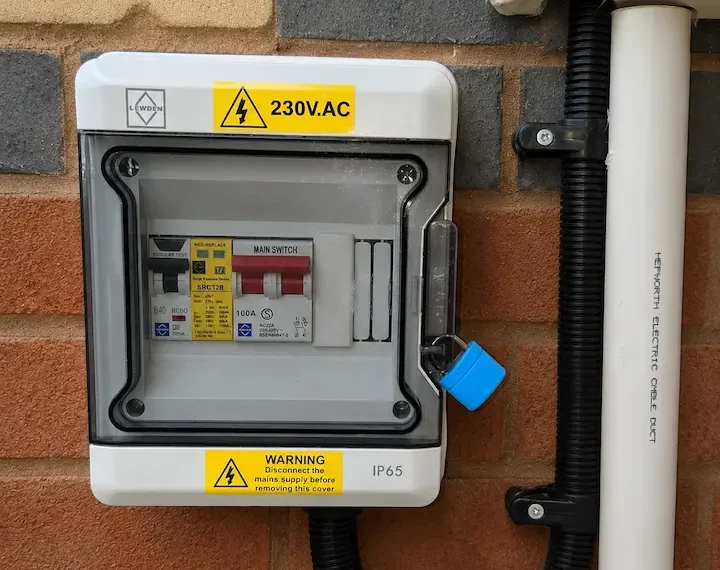
This photo shows a small weatherproof consumer unit Richard installed outside to supply a Rolec EV charger, giving a neater cable route near Banbury.
Is EV Charger Wiring Notifiable Work?
Yes. A new EV charger circuit in a domestic property is notifiable electrical work.
As with any new circuit in a dwelling, an EV charger circuit is notifiable under Building Regulations Part P. Part P is statutory, so it is a legal requirement rather than just a recommendation or best practice.
That means the work needs to be installed, tested and certified correctly, with Building Regulations notification where required.
RW Currion Electrical is Part P registered through NAPIT, so domestic EV charger installations can be notified properly. You should receive the correct electrical certification and Building Regulations compliance notification after the work is completed.
Related EV Charger Advice
If you are planning a home EV charger installation, these advice pages may also help:
• EV Charger Installation in Banbury
• EV Charger Advice
• Can My Consumer Unit Handle an EV Charger?
• What Is Load Balancing for EV Chargers?
• Can I Charge an EV From a Normal Socket?
• Can I Have an EV Charger Without a Driveway?
• Best Location for an EV Charger
EV Charger Installation in Banbury and Nearby Villages
If you’re thinking about having an EV charger installed at home, the wiring route is one of the most important parts of the job.
RW Currion Electrical installs dedicated home EV chargers across Banbury and the surrounding villages, giving homeowners a safer, faster and more convenient alternative to regular 3-pin plug charging.
• Dedicated EV charger circuits installed correctly
• Suitable protection such as Type A RCBOs and surge protection where required
• Consumer unit, earthing and bonding checked before installation
• Load balancing advice where the property supply needs it
• DNO notification handled where required
• Full testing, certification and Part P notification provided
• Clear advice on charger choice, cable routes and charger location
• Work carried out by Richard, an experienced electrician in Banbury
For regular EV charging at home, a dedicated charger is usually the better long-term solution. Learn more on our EV charger installation service page or contact Richard for honest advice.
Call now: 01295 533378
Mobile: 07740 100378